Not enough bone to support an implant doesn’t mean you’re out of options. Bone grafting has made implants accessible to far more patients than in years past. Here’s how it works and when it’s needed.
One of the most common concerns we hear from patients considering dental implants is: “What if I don’t have enough bone?” It’s a legitimate worry — missing teeth, especially over a period of years, often leads to bone loss in the jaw. But this concern doesn’t have to be a dead end. Bone grafting is a well-established, predictable procedure that has made implants possible for many patients who wouldn’t otherwise qualify.
At Belleview Dental Associates in Littleton, CO, we assess bone health as a standard part of every implant consultation, and we’re upfront about whether grafting will be part of your treatment plan. Here’s what you should understand about the process.
Why Bone Loss Happens After Tooth Loss
A natural tooth root continuously stimulates the surrounding jawbone every time you chew, signaling the body to maintain that bone’s density and volume. Once a tooth is lost — whether from extraction, decay, or gum disease — that stimulation disappears, and the body gradually resorbs the unused bone. This process can begin within months of tooth loss and continues progressively over time, which is one of the strongest arguments for replacing a missing tooth sooner rather than later.
Other contributors to bone loss include long-term denture wear (which doesn’t stimulate bone the way a natural root or implant does), periodontal (gum) disease, and certain injuries or infections.
How Your Dentist Assesses Bone Health
Before recommending an implant, your dentist evaluates both the quantity (height and width) and quality (density) of bone at the planned implant site. This typically involves:
- A clinical exam, checking gum health and the general contour of the jaw
- Digital X-rays, giving a two-dimensional view of bone levels
- A 3D cone-beam CT scan, providing a precise, three-dimensional map of bone volume and density — this is the gold standard for implant planning and grafting decisions
This assessment tells your dentist whether there’s enough healthy bone to support an implant as-is, or whether grafting is needed to build up the site first.
Types of Bone Grafting Procedures
Socket Preservation
Performed immediately after a tooth extraction, this involves placing bone graft material directly into the empty socket to minimize the natural bone loss that would otherwise occur during healing. This is often a proactive step for patients planning to get an implant in the future, even if it’s not immediately after the extraction.
Ridge Augmentation
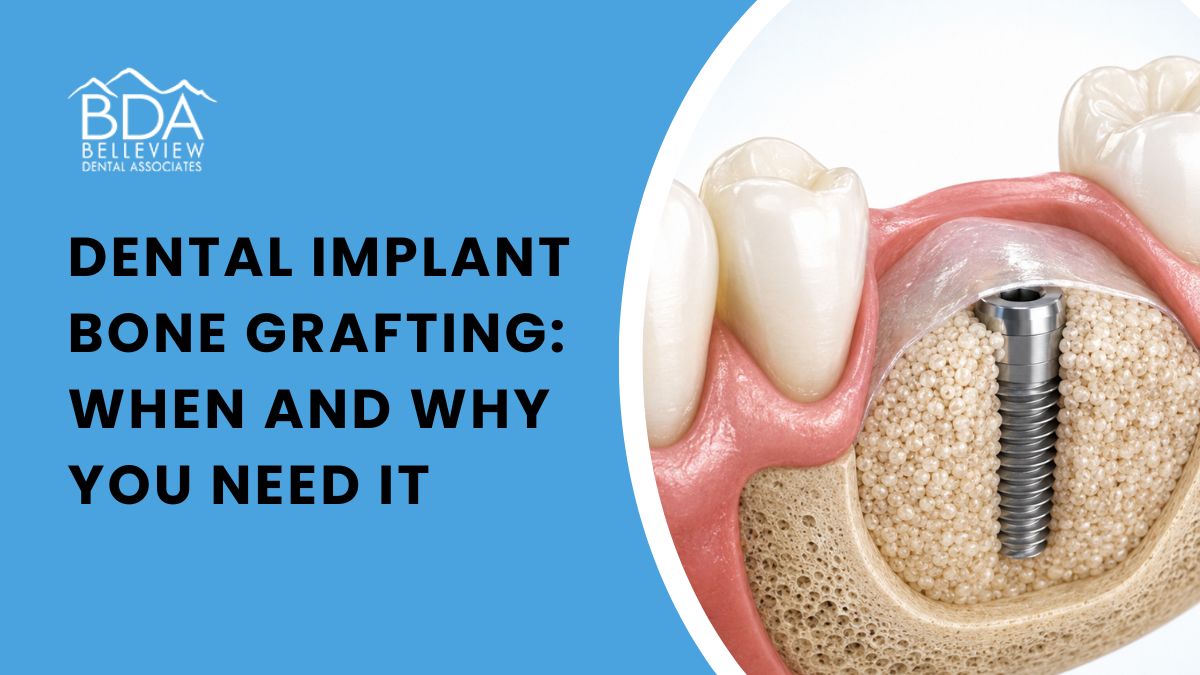
Used when the jawbone ridge has become too narrow or short to support an implant, this procedure rebuilds the width or height of the bone using graft material, allowing for proper implant placement afterward.
Sinus Lift (Sinus Augmentation)
In the upper back jaw, the sinus cavities sit close to the tooth roots, and bone loss in this area can leave insufficient space for an implant without encroaching on the sinus. A sinus lift procedure gently raises the sinus floor and adds bone graft material beneath it, creating adequate depth for implant placement.
Block Grafting
For more significant bone deficiencies, a small block of bone (either from another site in your own jaw or a specialized bone graft material) is secured to the deficient area, providing substantial structural rebuilding before implant placement.
What Bone Graft Material Is Actually Used?
Several types of graft material are used in modern dentistry, each with a solid research and safety record:
- Autograft — bone taken from another site in your own body, often the jaw or chin, offering excellent integration since it’s your own tissue
- Allograft — processed, sterilized bone from a human tissue bank, widely used and well-researched
- Xenograft — processed bone material derived from another species (commonly bovine), which acts as a scaffold that your body gradually replaces with its own bone over time
- Synthetic graft material — lab-created biocompatible materials designed to encourage new bone growth
Your dentist will recommend the option best suited to your specific case, the size of the defect, and your personal preferences.
What to Expect During and After Bone Grafting
Bone grafting is typically performed under local anesthesia, and many patients describe the experience as comparable to a tooth extraction in terms of discomfort. The graft material is placed at the site, often covered with a protective membrane, and the gum tissue is closed over it.
Recovery in the first week involves some swelling and mild discomfort, managed with pain medication and a soft diet. The graft material then needs time to integrate with your existing bone and mature into solid, implant-ready bone — a process that generally takes three to six months, depending on the size of the graft and your individual healing.
Does Bone Grafting Delay the Overall Implant Timeline?
Yes, when bone grafting is needed, it does add time to the overall process — typically several months of healing before implant placement can proceed. While this can feel discouraging if you’re eager to complete treatment, it’s an important investment in your outcome: placing an implant into inadequately prepared bone significantly raises the risk of implant failure down the road.
In some cases, particularly minor grafting situations, the graft and implant can be placed in the same appointment, shortening the overall timeline. Your dentist will let you know which approach applies to your specific situation.
Is Bone Grafting Painful or Risky?
Bone grafting is a well-established, routine procedure with a strong safety record. Discomfort is generally comparable to, or milder than, a tooth extraction, and is well managed with standard pain medication. As with any procedure, there are some risks — including infection or, rarely, the graft not integrating as expected — but these are relatively uncommon, especially when performed by an experienced provider following proper protocols.
Do You Definitely Need a Bone Graft?
Not necessarily. Many patients have entirely adequate bone for implant placement without any grafting at all, particularly if teeth were lost relatively recently or bone loss is minimal. Additionally, some implant techniques — like the angled implant placement used in All-on-4 full-arch restoration — are specifically designed to work with less bone, sometimes avoiding the need for grafting even in patients with noticeable bone loss.
The only way to know for certain is a thorough evaluation, including 3D imaging, which will give you and your dentist a clear, objective picture of your bone health.
Moving Forward With Confidence
Bone grafting has removed what used to be one of the biggest barriers to dental implants. With modern imaging and well-established grafting techniques, the vast majority of patients — even those with significant bone loss — can become excellent implant candidates with proper preparation.
Frequently Asked Questions
Will I need a bone graft if I’ve been missing a tooth for years? It’s more likely, since bone tends to resorb progressively the longer a tooth has been missing, but it isn’t automatic — a 3D scan will determine whether grafting is genuinely necessary for your specific case.
Can the implant be placed at the same time as the bone graft? Sometimes, particularly for smaller grafting needs. Larger grafts, like significant ridge augmentation or sinus lifts, typically require several months of healing before the implant itself can be placed.
Is graft material from another species safe to use? Yes — xenograft materials used in dentistry undergo extensive processing and sterilization and have a long, well-documented safety record. They act primarily as a scaffold that your own body gradually replaces with natural bone.
Does insurance typically cover bone grafting for implants? Coverage varies by plan. Some dental insurance policies provide partial coverage for grafting procedures, particularly when documented as medically necessary for implant placement. Our team can help verify your specific benefits.
Find Out What Your Bone Health Looks Like
If you’re considering dental implants and are unsure whether you have enough bone, the best next step is a thorough evaluation with 3D imaging. Our team at Belleview Dental Associates in Littleton, CO will give you a clear, honest picture of your bone health and outline exactly what your treatment path would look like.
Schedule a consultation today to find out where you stand and what your options are.