For patients missing most or all of their teeth, All-on-4 offers a way to walk out with a full, functional smile the same day surgery is performed. Here’s how it works and who it’s really for.
Losing most or all of your teeth — whether from advanced decay, gum disease or years of wear — doesn’t mean your only options are traditional dentures. All-on-4 dental implants have transformed full-mouth restoration, offering a fixed implant-supported solution that’s more efficient, stable and less invasive than many patients expect.
At Belleview Dental Associates, we help Littleton, CO patients understand whether All-on-4 is the right fit for their situation and what a realistic outcome looks like. Here’s a detailed guide.
What Is All-on-4?
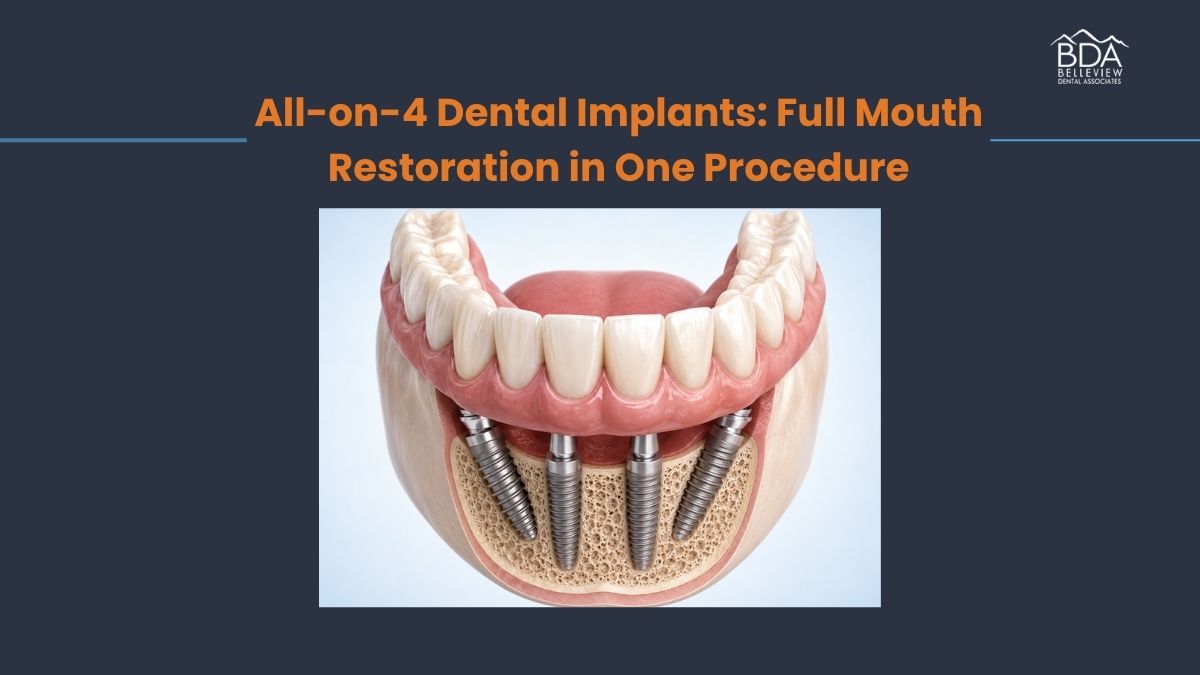
All-on-4 is a full-arch tooth replacement technique that uses just four strategically placed implants to support an entire arch of prosthetic teeth — either the upper jaw, lower jaw, or both. Rather than placing an implant for every missing tooth (which could mean 8 or more implants per arch), All-on-4 uses a smaller number of implants positioned at precise angles to maximize contact with available bone, often eliminating the need for a bone graft even in patients with some bone loss.
The name comes from the standard four-implant design, though some cases use five or six implants (sometimes called All-on-5 or All-on-6) depending on individual bone structure and support needs.
How the Angled Implant Placement Works
The back two implants in a typical All-on-4 arrangement are angled at roughly 30 to 45 degrees, rather than placed straight up and down. This angling allows the implants to engage denser, more available bone — often avoiding areas like the sinus cavity in the upper jaw or the nerve canal in the lower jaw that can otherwise limit implant placement. This clever engineering is a major reason All-on-4 can often be completed without extensive bone grafting, even in patients who’ve experienced significant bone loss from long-term tooth loss.
The All-on-4 Procedure Overview
- Comprehensive evaluation — including 3D CT imaging to assess bone volume and plan precise implant positioning
- Removal of remaining unhealthy teeth (if applicable), often performed the same day as implant placement
- Placement of four (or more) implants at strategic angles into the jawbone
- Attachment of a temporary full-arch prosthesis the same day, giving patients functional, good-looking teeth immediately
- Healing period of several months for osseointegration to occur while wearing the temporary prosthesis
- Placement of the final, custom-fabricated full-arch restoration once healing is complete
Same-Day Teeth: What’s Realistic
One of the most appealing aspects of All-on-4 is that most patients leave their surgery appointment with a full set of fixed, functional teeth — not the final restoration, but a well-made temporary prosthesis designed to look natural and allow normal (though initially careful) eating and speaking. This is a major quality-of-life advantage over traditional implant approaches, where patients might go months without a fixed replacement in the treatment area.
It’s important to set the right expectations, though: this temporary prosthesis is generally lighter-duty and requires a softer diet during the healing period, while the jawbone fuses to the implants beneath the surface. The final, more durable restoration is fabricated and placed after healing is complete, typically around four to six months later.
Who Is a Good Candidate for All-on-4?
All-on-4 is generally well-suited for patients who:
- Are missing most or all teeth in an arch, or have failing teeth that will need extraction
- Want a fixed (non-removable) full-arch solution rather than a traditional denture
- Have experienced some bone loss but want to avoid extensive bone grafting
- Are in good enough general health to undergo implant surgery
- Want to minimize the number of implants, appointments and overall cost compared to replacing every individual tooth
Patients who smoke heavily, have uncontrolled diabetes or have very severe bone loss may need additional evaluation or preparatory treatment, though many can still be candidates with proper management.
All-on-4 vs. Traditional Full-Mouth Implants
Traditional full-arch implant restoration might use six to eight (or more) implants per arch, each replacing an individual tooth’s root. This approach can offer certain advantages in specific cases but generally requires more implants, a higher upfront cost and often more extensive bone grafting for patients with bone loss.
All-on-4 offers a more efficient alternative for many patients: fewer implants, often no grafting required, a same-day temporary prosthesis and a typically lower overall cost — while still providing a fixed, stable, implant-supported result.
All-on-4 vs. Traditional Dentures
Compared to a traditional removable denture, All-on-4 offers dramatically improved stability, since the prosthesis is fixed to the implants rather than resting on the gums and relying on suction or adhesive. This translates to better chewing efficiency, no denture slipping while speaking or eating, and — critically — ongoing bone preservation, since the implants continue to stimulate the jawbone the way natural tooth roots do. Traditional dentures, by contrast, allow continued bone loss over time, which can gradually change facial structure and denture fit.
What Recovery Looks Like
Recovery after All-on-4 surgery is generally similar to other implant procedures, though because it often involves extractions and multiple implants in one visit, initial swelling and discomfort may be somewhat more pronounced than a single-implant case. Most patients manage this with prescribed pain medication and a soft-food diet for the first several weeks, gradually progressing as healing continues. Full osseointegration before the final restoration typically takes four to six months.
Caring for All-on-4 Restorations Long-Term
Even though the prosthetic teeth themselves can’t decay, the gum and bone tissue around the implants require the same diligent care as natural teeth or single implants. This includes daily cleaning underneath and around the prosthesis (your dentist will show you specific techniques and tools for this), regular professional checkups and prompt attention to any looseness or irritation. With good care, All-on-4 restorations are designed to last many years, with the underlying implants often lasting decades.
Realistic Outcomes: What to Expect
All-on-4 offers dramatic, life-changing results for patients who’ve been struggling with failing teeth or uncomfortable dentures — a fixed, natural-looking, stable set of teeth without needing an individual implant for every missing tooth. That said, it’s a significant surgical undertaking with a real healing timeline and results depend heavily on your bone quality, overall health, and commitment to aftercare. A thorough consultation is the only way to know what your specific outcome and timeline will look like.
Frequently Asked Questions
How long do I keep the temporary teeth before getting the final set? Typically four to six months, while the implants fully integrate with the jawbone. During this time, the temporary prosthesis is designed to look natural and function well, though a somewhat softer diet is recommended.
Is All-on-4 painful? Discomfort is generally manageable with prescribed pain medication and is often comparable to, or only somewhat more involved than, a standard tooth extraction, since the procedure frequently combines extractions and implant placement in one visit.
Can All-on-4 fail? As with any implant procedure, complications are possible, though success rates are generally strong in well-selected candidates. Good oral hygiene, avoiding tobacco use and smoking and attending regular checkups all support long-term success.
Is All-on-4 reversible if I change my mind later? The prosthetic teeth can be adjusted or remade, but the implants themselves are a long-term, permanent fixture. Most patients who choose All-on-4 do so specifically because they want a fixed, non-removable long-term solution.
Explore All-on-4 at Belleview Dental Associates
If you’re dealing with failing teeth or an uncomfortable denture and want to explore whether All-on-4 is right for you, our team in Littleton, CO is here to provide an honest, thorough evaluation.
Schedule a consultation with Belleview Dental Associates today to find out if All-on-4 full-mouth restoration could be the solution you’ve been looking for.