Missing one tooth, several, or a full arch? Here’s an honest, side-by-side comparison of your restoration options to help you choose the right path forward.
Losing a tooth — or several — is more common than many people realize, and the good news is you have real, effective options for restoring your smile. The challenge is that dental implants, bridges, and dentures each work differently, come with different costs, and are better suited to different situations. There’s no single “best” option for everyone.
At Belleview Dental Associates, we help Littleton, CO patients weigh these options honestly, based on their oral health, budget, and lifestyle. Here’s a clear breakdown of each choice.
Dental Implants: The Long-Term Standard
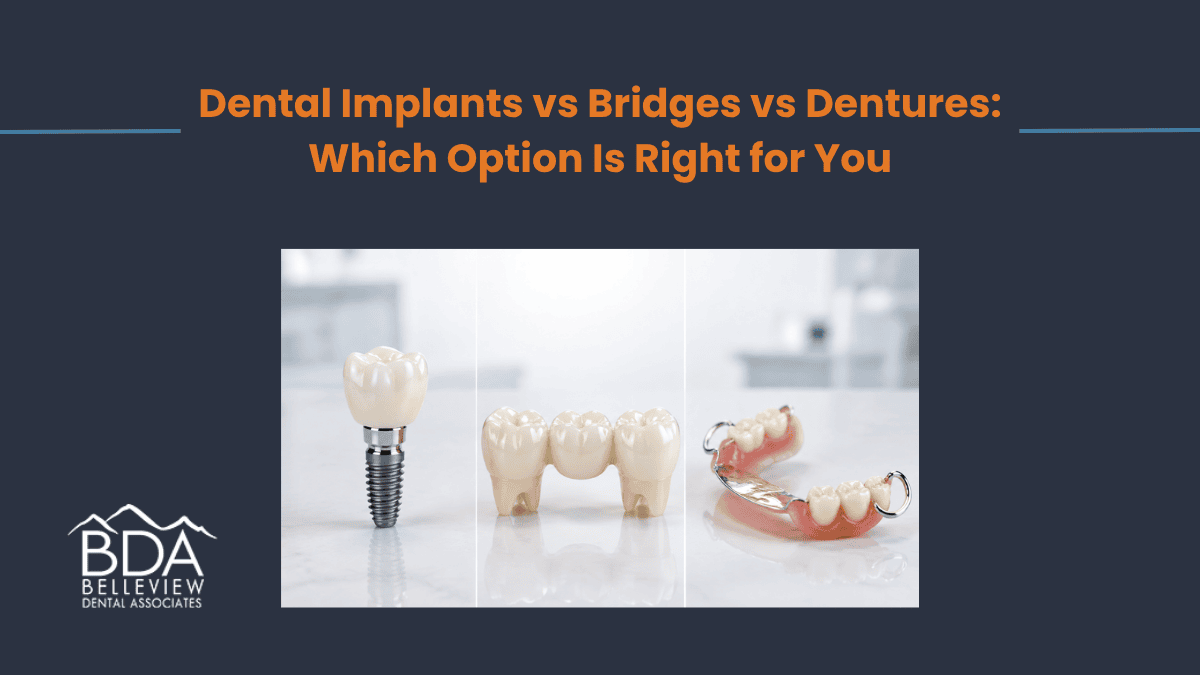
A dental implant replaces the entire tooth structure — root and crown. A titanium or zirconia post is surgically placed into the jawbone, where it fuses with bone over several months. A custom crown, bridge, or denture is then attached on top.
Pros:
- Look and function like natural teeth
- Preserve jawbone by stimulating it the way a natural root would, preventing the bone loss that occurs with missing teeth
- Don’t rely on neighboring teeth for support, so adjacent healthy teeth aren’t altered
- Extremely durable, often lasting 20+ years or a lifetime with proper care
- No special cleaning routines beyond normal brushing and flossing
Cons:
- Higher upfront cost compared to bridges or dentures
- Requires a surgical procedure and a multi-month healing timeline
- Requires adequate bone volume, or a bone graft beforehand
- Not ideal for patients with certain uncontrolled health conditions or heavy smokers, though many can still qualify with proper management
Best for: Patients missing one or several teeth who want the most natural-feeling, longest-lasting solution and are comfortable with the timeline and investment involved.
Dental Bridges: A Faster Fixed Option
A traditional bridge replaces a missing tooth by anchoring a false tooth (pontic) to the crowns placed on the two adjacent natural teeth. It’s a fixed restoration, meaning it doesn’t come out for cleaning like a denture would.
Pros:
- Faster process, typically completed in two to three appointments over a few weeks
- No surgery required
- Fixed in place, so there’s no adjustment period for speaking or eating
- Generally less expensive upfront than an implant
Cons:
- Requires reshaping (and permanently altering) the two healthy adjacent teeth to support the crowns
- Doesn’t stimulate the jawbone, so bone loss continues under the missing tooth area over time
- Typically lasts 10–15 years before needing replacement
- If one supporting tooth develops decay or fails, the entire bridge may need to be redone
Best for: Patients missing one or a few teeth who want a quicker, non-surgical fixed solution, or whose adjacent teeth already need crowns for other reasons.
Dentures: Full or Partial Tooth Replacement
Dentures are removable appliances that replace some (partial denture) or all (full denture) of the teeth in an arch. Modern dentures are custom-fitted and far more comfortable and natural-looking than older versions many people remember.
Pros:
- Most affordable option upfront
- Non-surgical, quicker to obtain
- Can replace an entire arch of teeth at once
- Removable for cleaning
Cons:
- Can shift or feel loose, especially over time as the jawbone naturally shrinks after tooth loss
- May require adhesives for a secure fit
- Often need relining or replacement every 5–8 years as your mouth changes shape
- Can affect chewing efficiency and, for some patients, speech
- Don’t stop bone loss the way implants do, which can gradually change facial structure over years
Best for: Patients missing most or all teeth in an arch who want a lower-cost, non-surgical option, or who aren’t currently candidates for implant surgery.
Implant-Supported Dentures: A Middle Ground
For patients missing a full arch of teeth, there’s a hybrid option worth knowing about: implant-supported (or implant-retained) dentures. A small number of implants — often four to six — are placed in the jaw, and a denture snaps securely onto them. This combines the affordability and full-arch coverage of dentures with much greater stability and reduced bone loss compared to traditional dentures.
Side-by-Side Comparison
| Factor | Implants | Bridges | Dentures |
| Surgery required | Yes | No | No |
| Alters adjacent teeth | No | Yes | No (may use clasps for partials) |
| Prevents bone loss | Yes | No | No |
| Typical lifespan | 20+ years | 10–15 years | 5–8 years |
| Timeline to completion | 3–8 months | 2–4 weeks | 4–8 weeks |
| Upfront cost | Highest | Moderate | Lowest |
| Feels like natural teeth | Very close | Close | Less so, can shift |
Questions to Ask Yourself
Choosing between these options often comes down to a few honest questions:
- How many teeth am I replacing, and where are they located? A single back tooth has different priorities than a full upper arch.
- What’s my timeline? If you need a solution quickly for an upcoming event, a bridge or denture may fit better than the months-long implant process.
- What’s my budget, both now and long-term? Implants cost more upfront but often save money over decades by avoiding repeated replacements.
- What’s my bone health? Adequate jawbone volume is necessary for implants, though grafting can often address this.
- Do I want to protect my remaining healthy teeth? If so, implants and dentures avoid altering adjacent teeth, while bridges do not.
- How important is stability when eating and speaking? Implants offer the most confidence; traditional dentures the least.
There’s No Universal “Best” Choice
Each of these options has a legitimate place in modern dentistry. A single missing molar in a patient with excellent bone density is often an ideal implant case. A patient missing all their teeth who wants a same-day, budget-conscious solution might be better served initially by a well-fitted denture, potentially transitioning to implant-supported dentures later. The right choice depends entirely on your unique mouth, health, goals, and circumstances.
Frequently Asked Questions
Which option is cheapest upfront?
Dentures typically carry the lowest upfront cost, followed by bridges, with implants generally being the highest initial investment. However, implants often prove more cost-effective long-term since they typically don’t require replacement every decade or so.
Can I switch from dentures to implants later?
In many cases, yes. Patients who start with a traditional denture sometimes transition later to an implant-supported denture or individual implants, provided sufficient bone remains or grafting is used to rebuild it.
Do bridges damage the adjacent teeth?
The adjacent teeth need to be reshaped to accept the bridge’s supporting crowns, which is a permanent alteration. Those teeth also bear extra chewing load. This is one of the main long-term trade-offs compared to implants.
Will insurance cover any of these options?
Coverage varies significantly by plan and procedure. Many dental insurance plans provide some benefit toward bridges and dentures, and increasingly toward implants as well. Our team can help you understand your specific coverage during a consultation.
Get a Personalized Recommendation in Littleton, CO
The best way to know which option fits your situation is a thorough evaluation with a dentist who will walk you through the honest pros and cons for your specific case — not just push the most expensive option. At Belleview Dental Associates, we take the time to understand your goals, examine your oral health, and recommend the restoration that truly makes sense for you.
Contact our Littleton office today to schedule a consultation and get clarity on the best path forward for your smile.